


HYDRATION & FUELLING GUIDE FOR MARATHONS
Hydration, Energy and The Infamous Wall
“Hitting the wall” is a state no athlete wants to experience. It feels like going face-first into a brick wall. The “wall” is often associated with marathons, occurring at about the 30km mark, when an athlete literally runs out of energy. But the good news is that athletes never have to encounter “the wall” with the right training, the right fuelling and the right hydration. This guide will give you some insight into what fuel and hydration are needed for a successful marathon and how to go about it.
Aside from being well-trained and rested, an athlete needs to cater for both energy and hydration on the big day itself. Energy and hydration are often lumped together, but the truth is they are different physiological systems. Both require understanding and planning.
Your Energy System
Energy is made in your body by converting stored carbohydrates and stored fat into ATP. This happens in your mitochondria. Your body stores carbohydrates as glycogen, mostly in your muscles and liver. Glycogen is literally glucose, a form of sugar. Fat is stored in your adipose tissue (fat cells), with small amounts stored in your muscle cells.
Carbs are your fast-acting energy source, but storage is limited. You can only store about 500g of glycogen, enough for approximately 2,000 Calories of energy. Fat is a slower source of energy, but it is virtually unlimited.
Your body is like a hybrid engine, always burning both carbs (glycogen) and fat together. A common mistake is to think it’s one or the other. The ratio is what matters. You may burn 20:80 while walking, 50:50 during a slow run and 80:20 on a faster run - the first number is the percentage of energy from glycogen and the second is the percentage from fat. As you can see, the higher the intensity, the greater the dependence on glycogen. During a marathon, you will use a lot more glycogen than during a slow, gentle run because marathons are long and intense. After all, it’s a race!
Remember that glycogen stores are limited, so you will run out if you don’t replace glycogen during the marathon, by consuming fast-acting carbs like sugars and starches. Fat does not need to be replaced. Replacing glycogen stores is really the goal of “fuelling”.
The Goal Of Fuelling and Hydration
Your fuelling strategy is all about the amount, timing and form of carbs that you consume before and during the event. They can be in liquid, gel or solid form and you can use endurance fuel products, energy bars or real food.
Hydration, on the other hand, is about maintaining your body’s fluid balance and the minerals (called electrolytes) needed to send electrical signals to nerves and muscles.
Preventing cramps is, to a large extent, also about having enough fluid, sodium and magnesium. Potassium functions inside your cells and helps maintain nerve function and heart rhythm. Because you’re losing fluid and minerals while sweating, you need to replace them.
One important thing to note - you cannot hold water without the sodium, which is why drinking plain water during a long endurance event can be dangerous – it dilutes your remaining sodium and can literally flood your brain, a condition called hyponatremia. Drinking plain water isn't an issue in everyday life because our kidneys have time to regulate fluid balance, but it is an issue during endurance events.
REVIVE Is a Pure Electrolyte
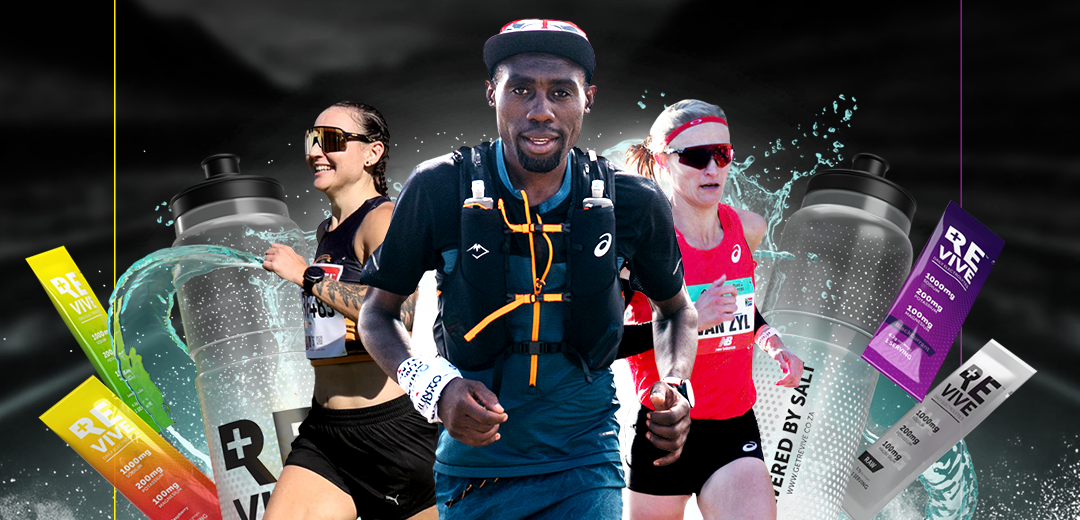
REVIVE is a pure electrolyte, meaning it contains only electrolytes and no energy. Remember, hydration and energy are different systems in the body. REVIVE gives you a perfect ratio of sodium, potassium and magnesium in a “clean” format, which protects your health. No unnecessary additives, no funny chemicals, no weird colouring. It comes in a powdered sachet which is mixed with water.
An athlete loses about 1,100mg of sodium per litre of sweat. Not only does REVIVE have the right ratio of electrolytes, but the higher sodium levels replace what you actually lose. REVIVE contains 3-4 times more sodium than most other products, all derived from natural, unprocessed desert salt (Oryx Desert Salt).
Now, if you use REVIVE for hydration, you’ll need to take care of your energy requirements separately during a marathon (we’ll explain), but during shorter training runs, you just need water and electrolytes.
Doesn’t Hydration Require Sugar?
The idea that electrolytes need sugar is often misunderstood and taken out of context. Your body absorbs electrolytes without sugar, the same way you absorb salt with your food. Sugar speeds things up, but it comes at a cost to your health. We leave out the sugar because we are a health company. Speed isn’t a problem during an exercise event – it’s a problem when dying of dehydration. The context matters.
By providing a pure electrolyte without sugar, REVIVE gives you the flexibility of adding sugar or carbohydrates when you need energy and avoiding them when you don’t. This protects your health because consuming sugar every time you exercise isn’t good for you. It also makes REVIVE a great fasting and health product, not just a great performance product. Therein lies the magic. REVIVE is a versatile hydration product designed for your daily hydration needs as well as your performance needs.
Using REVIVE For A Marathon
The amount of sodium, potassium and magnesium in REVIVE, and the ratio between these key electrolytes, will provide the perfect hydration mix. When added to water, you'll get the right balance of fluid and minerals to replace what you lose, prevent cramps and power your performance. However, because REVIVE doesn't contain energy, don't forget to consume your choice of fast-acting carbs as well. Our Ten Tips below will show you how to do this practically and accurately.
TEN MARATHON TIPS
1. Hydration Before the Start:
Mix 1 REVIVE sachet in 500ml of water. Drink 250ml before the start. Sip it over 15 minutes. This is called pre-hydration. Aim to finish drinking 1 hour before the start. The pre-race electrolytes should be a bit more concentrated (less water) than usual to prevent unnecessary toilet visits.
You can save the remaining 250ml for recovery afterwards and add 200ml more water to it later. To complete your post-race recovery, mix another fresh sachet in 1L of water and sip slowly in addition to your leftover bottle.

2. Hydration During:
Consume 1 sachet of REVIVE per 90 minutes of running. Each sachet should be diluted in 500ml – 750ml water, depending on your taste preference. Less water is easier to drink. Based on your running time, this will equate to 2 - 4 sachets consumed during the 42.2km run. Here’s a guide:
• Sub 3 hour:2 sachets of REVIVE
• 3h00 – 4h30:3 sachets of REVIVE
• 4h30 – 6h00:4 sachets of REVIVE

3. Practical ways to hydrate:
• Hydration vest:carry your hydration in a vest with premixed REVIVE in your soft bottles. Use 1 sachet per 500ml soft bottle. You can always get more water on the route.
• Dry sachet:consume the powder directly by swallowing it; drink water at aid stations along the route or when the opportunity presents.
• Mix at water points:this is a bit more time-consuming, so plan carefully. You’ll usually get a cup of water which you can’t shake, so just pour the sachet into the cup of water and drink it. If the water comes in bottles, it’s easier to mix because you can give the bottle a shake.
• Pre-made bottles from your support team along the route.This is easiest if you have the luxury of a support team or some committed friends.

4. Continuous Hydration is Key:
Don't wait until you're dehydrated - drink throughout the race to stay ahead of your hydration. Start in the first 30 minutes of the race. Sip regularly if you can, rather than gulping down big quantities of fluid. But, if you’re not carrying your hydration with you, use the water points as soon as possible.

5. Use REVIVE RAW Strategically:
REVIVE RAW is our unflavoured, unsweetened electrolyte sachet. It tastes, well… pretty RAW, but it’s light, containing only 3.7g per sachet. You can use it as a dry sachet or add it to any other drink mix to boost your hydration. Some runners suffer from flavour fatigue during a long run and get tired of the sweetness from all the different products. REVIVE RAW can offer a welcome break from flavours, towards the end of your marathon.

6. Fuel with 50g – 125g of carbs per hour:
During the marathon, you’ll burn about 3,000 Calories as a 70kg woman and 3,500 Calories as an 83kg man. Your fuelling rate depends on how fast you’re going. Based on your marathon time, here is a guide to how much energy, in the form of fast-acting carbohydrates, you need to consume per hour:
|
|
|
Marathon Time (Hours) |
||
|
|
|
3H:00 |
4H:00 |
5H:00 |
|
|
Weight (kg) |
Carbohydrate Intake (g/hour) |
||
|
Woman |
70 |
90 |
65 |
50 |
|
Man |
83 |
125 |
95 |
75 |

7. Measure The Fast-Acting Carbs:
Fast acting carbs are starches and sugars that can be absorbed easily. Fasting-acting means quickly converted to glucose and able to be used as energy.
Gels and sports drinks abound and new products are introduced all the time. They are convenient to use and carry. Read the nutritional information carefully so you can see how much carbohydrate you’re getting and plan your race accordingly. Each gram of carbs provides 4 Calories. Your taste preferences are important, so try out different products to see which you like.
A special place must be reserved for a brand called Maurten. Their hydrogel technology bypasses the constraints of the human gut, allowing more carbohydrates to be absorbed. If you’re aiming to take in 125g of carbs per hour, you’ll probably need to rely on Maurten. Humans can’t absorb more than about 90g of carbs per hour. Use products that have more glucose and maltodextrin and less fructose.
Real food has an important role to play. Focus on easy-to-digest, easy to carry foods. Use Google for the carbohydrate content and ignore fibre – it is a carb but it won’t provide energy.

8. Protect Your Gut:
All the planning in the world counts for nothing if your gut plays out. Two things to remember. Race days mess with your nerves and your sleep, resulting in a more fragile gut than usual. So, make sure you eat only things that are well-tolerated and well-tested. Secondly, the physical stress of a marathon means that your gut behaves differently at 32km than it does normally, so stress-test your nutrition and hydration on your longer runs.

9. Remember your pre-race meal:
Your pre-race meal is an important source of fuel so don’t waste it. Focus on easy-to-digest carbohydrates. A bagel or 2 pieces of toast with peanut butter and a banana is a good example. Oats with some honey and a banana is another good one. Bananas are good because they are easy to digest, high in potassium and also have sugar for energy.

10. Race Day Isn’t Practice:
Do not do anything on race day that you haven’t tried in practice, especially on long runs which simulate a more accurate marathon distance. What happens over 42.2km doesn’t happen over 10km!





Leave a comment (all fields required)